Hans-Peter Geissen
Hans-Peter Geissen lives in Koblenz (Germany), at the confluence of the Rhine and Moselle rivers. Interested in all what concerns faunistics (data about animal species) of the Midrhine region, he is the author of many scientific publications on these issues. He bent on the Turkish issue with a very specific approach so as « to prevent a self-definition of Europe on the grounds of historical or religious mythologies. »
Articles de cet auteur (35)
-
The last Turkish junta and the nazi « Machtergreifung »
9 mars 2010« ... it really did not look like a hotel. It rather resembled, to be honest, Auschwitz. » (Mustafa Akyol, A farewell to rulers in arms Tuesday, February 23, 2010)
Well, for German readers and those with specific historical insight, the better comparison would have been Dachau, or Buchenwald. You know, the first generation of Concentration Camps, or KZs, which targeted German politicians and unionists in first line. By the way it included some religious people, homosexuals, artists, and (...) -
’Meds Yeghern’
6 mai 2009After the official statement of American President Barack Obama, which once more expressed strong emotions and convictions about history and morality, a majority of Turkey’s commentators seems to have taken down the gloriole of this newest Messiah of the West. Disappointment and a healthy dose of sceptizism result basically from the wordless passing over the Muslim victims of the same period, as the contrast, naturally, hints at an emotionless and amoral attitude when the issue are Muslim (...)
-
EU - Turkey : Drawing a sketch
14 avril 2009As could be expected, a look in the local-regional German press -which in general is closer to the average citizen than to theories- reveals that the Nato-incidents are seen as expression of Turkey’s « non-European character ».
The Bavarian CSU, which has been in steady decline for some time, will definitely build their federal and particularly the European election campaigns on rejection of Turkey’s EU accession. While their chances appear quite promising so far, this is of secondary (...) -
Ergenekon, AKP and the Dogan’s case
25 February 2009Has the “Ergenekon” criminal network infiltrated Turkey’s ministry of finance? Because, this organization is said to create political tension and havoc through targeted assassinations which backfire against a third party. In our case, the ministry of finance shot at the Dogan Media Group, and in all probability it will backfire at the Prime Minister or maybe rather at Turkey.
If the answer is negative, the question itself may be revised: Is “Ergenekon” indeed a distinct organization or rather a (...) -
Gül feels empathy with Turkish Jews
29 January 2009ISTANBUL - Concerns of the Jewish community in Turkey about a possible enmity toward them over the Israeli attacks in Gaza are once again on the agenda. Now, President Abdullah Gül has expressed his sensitivity to the issue of the Turkish Jew who in an article for daily Radikal stated that she was scared, sad and anxious about being a Jew in Turkey.
The psychologist Leyla Navaro’s article “Being a Jew in Turkey: Loneliness of 500 years,” drew reference to the statement by Erdoğan that 500 (...) -
Has Turkey’s EU-accession process become counterproductive?
26 November 2008A basic explanation, just to determine what I’m talking about: Essentially the European Union is about sovereignty-sharing between sovereign nations -meaning collective sovereigns of states- in Europe. The implicated core values are freedom (stands for sovereign) and equality (for collective); the structural implications/requirements are known as rule of law and democratic system/procedures. About these values and structures a national consent (agreement, compromise) is required. (In (...)
-
Kafkasya Hesapları
26 Eylül 2008Uzun ve karışık tarihe sahip olan ’’Trans’’ ya da Güney Kafkasya bölgesi, geçtiğimiz haftalarda yaşanan savaş nedeniyle, Avrupa ve dünya kamuoyunun dikkatini her zamankinden daha çok çekti. Savaşın tamamen bitmemesine karşın, fiili «blitzkrieg» (sürpriz saldırı) sona erdi ve yerini diplomatik ve insani mücadelelere bıraktı.
Bunu anlamak için, şu soruyu sormak zorunda olduğumuzu düşünüyorum: Ruslar neden Gürcistan eyaletleri olan Abhazya ve Güney Osetya’nın ’’bağımsızlıklarını’’ tanıdılar ?
Rusya için, bu hamlesi bir (...) -
Caucasian gambit
10 septembre 2008More than ever in its long and complicated history, the « Trans- » or Southern Caucasus region has captured the attention of a broad European and global public with military events in recent weeks. Though the war is not yet fully over, the actual « blitzkrieg » ended soon and was replaced by diplomatic and humanitarian struggles.
Trying to understand, it appears to me that there remains a stunning question : why did the Russians recognize the « independence » of the Georgian provinces of (...) -

Making nation from history. A challenge (4)
19 June 2008Turkish nationalism is a puzzling enigma, which may be manifest on the level of its main protagonists. After some considerations on the mystery of the nascent Turkish nationalism, and a analysis of the notion of ethnicity, Hans-Peter Geissen shed some light on the conditions for Turkey to become a nation-state.
First Article
Second Article
Third article
Backside Nonetheless, this pluralism did not mean equality but a hierarchy with Muslim superiority and gradually declining order (...) -

Making nation from history. A challenge (3)
13 juin 2008Turkish nationalism is a puzzling enigma, which may be manifest on the level of its main protagonists. After some considerations on the mystery of the nascent Turkish nationalism, Hans-Peter Geissen examines what could have been the real scope of a notion like ethnicity under the Ottomans...
First Article
Second Article
The Ottoman sultans used various titles and qualities to describe (emphasize) themselves, including such like « (K)Han » (traditional for Turko-Mongol leaders), « Cesar (...)
Le dessin de la semaine
-
Je suis Charlie
8 janvier 2015, par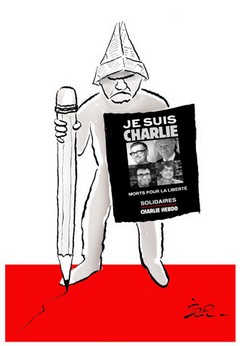
- Je suis Charlie
- Izel Rozental
Les auteurs
- Adam Wade
- Célia Chauffour
- Elvira Corona
- Estelle Laurent
- FAİK KAPTAN
- Gülay Göktürk
- Kristen Stevens
- Martti Ahtissari
- Olivier Truc
- Thierry Oberlé
- 20 minutes
- 7sur7
- A Ta Turquie
- A.F.
- Abdullah Bozkurt
- Abdullah Gül
- Abdullah Türkmani
- Açikçay
- ACORT
- Adel LATRECH
- Afif Lakhdar
- AFP
- AFP
- Agence Fish Presse
- Agnès Cerbelaud Salagnac
- Agnès LE MORVAN
- Agnes Rotivel
- Ahmet Altan
- Ahmet Altan
- Ahmet Insel
- Ahmet Necdet Sezer
- Ahmet Şık
- Ahmet Soysal
- Ait Aoudia Djaffer
- Akın Özçer
- Alain Badiou
- Alain Barluet
- Alain Beuve-Méry
- Alain Bockel
- Alain Duhamel
- Alain Frachon
- Alain Garrigou
- Alain Gresh
- Alain Mascarou
- Alain Valtat
- Alban Bodineau
- Albert Tshiambi
- Alda Engoian
- Alexandra Schwartzbrod
- Alexandre Adler
0 | 50 | 100 | 150 | 200 | 250 | 300 | 350 | 400 | ... | 1200

 RSS 2.0